The Go Game · Head of Product & Design
Event Manager Dashboard
Nov 2020 - July 2023
Transformed a white-glove, services-heavy operation into a scalable self-serve product platform: one dashboard that absorbed the operational complexity.
TL;DR: Transformation & Impact
Key Outcomes
- 2× event capacity: automation removed the ops bottleneck
- +12% rebooking rate from a smoother customer journey
- 34% reduction in customer setup time
- One unified dashboard replaced spreadsheets, docs, DMs, and disconnected tools
- Used by Fortune 500 companies (Google, Facebook, Amazon)
What Changed
Context
The Go Game is a team-building and corporate events company that pivoted to hybrid (virtual + in-person) experiences during COVID. The company had built a successful events business serving Fortune 500 clients including Google, Facebook, and Amazon.
As Head of Product & Design, I owned the entire product organization. My job was to turn a professional services company into a scalable software platform. That meant productizing institutional knowledge and manual processes that had built up over years.
Challenge
Revenue demand exceeded operational capacity. Growth was capped by how much work humans could personally handle:
- Disconnected tooling: Core workflows were spread across many disconnected tools, held together by spreadsheets, docs, and DMs.
- Knowledge in people's heads: Every event required heroic manual coordination, and only senior staff could safely run complex events.
- High error risk during live execution: Manual handoffs meant dropped balls, missed reminders, and coordination failures in front of clients.
- Weak customer-facing configuration portal: Ops absorbed setup work that customers could have done themselves.
What I Did
Designed for Real Surfaces, Not Job Titles
Customers booking events, internal ops coordinators, and hosts running events live each needed a different control layer. Progressive disclosure by role kept each surface simple without hiding the underlying system.
Unified the System Instead of Adding Tools
Core workflows were spread across many disconnected tools, and critical knowledge lived in people's heads. Replacing them with one control surface cut context switching and error risk during live execution.
Tradeoff: Chose depth over breadth: focused on most-used workflows rather than full parity with every tool.
Automated the Highest-Frequency Pain
Focused automation on the work humans repeated every single event, not edge cases. That is what removed the ops bottleneck and doubled event capacity.
Tradeoff: Low-usage, high-complexity event types stayed manual longer.
Impact & Results
Ops stopped relying on ad-hoc docs and DMs to run events, errors dropped during live execution, and setup got faster with less senior oversight. The second-order effects mattered just as much: lower marginal cost per event, services teams shifted from glue work to higher-value tasks, and self-serve became viable for more customers.
2×
Event Capacity
+12%
Rebooking Rate
-34%
Customer Setup Time
Event Manager Dashboard
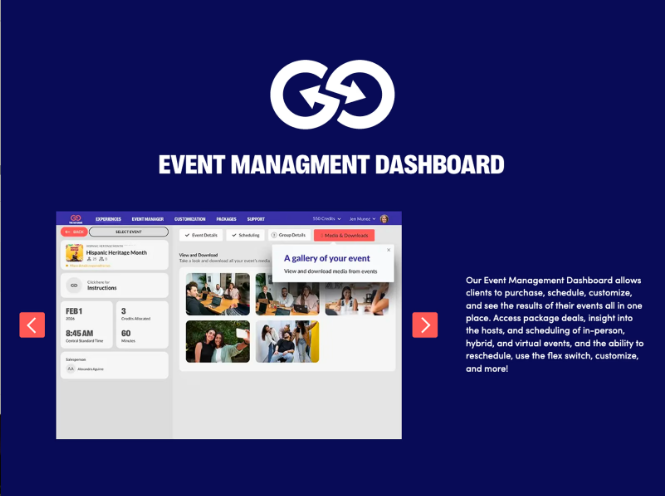
Event Management Dashboard: one control surface for customers, ops coordinators, and hosts
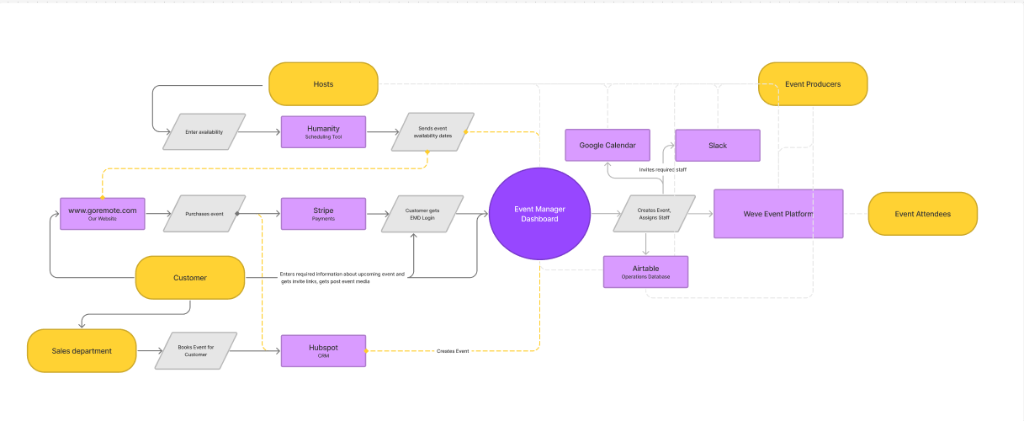
System architecture: how the Event Manager Dashboard connected all upstream booking flows and downstream delivery tools
Key Takeaways
Pull Revenue-Visible Features Earlier
The ops wins were real but invisible to buyers. Customer-facing improvements moved rebooking and deserved earlier slots on the roadmap.
Push Back on Low-Usage, High-Complexity Event Types
A small set of rare event formats consumed outsized build and support effort. Saying no sooner would have freed capacity for the workflows that ran every week.
Delay Hierarchy Models Until Usage Patterns Are Proven
Formalizing structure before real usage data locks it in too early. Ship flat, watch how people actually work, then model it.
Next Case Study